


Substrate
PREFA roof products are to be installed on a fully supported substrate. Requirements from national standards and regulations must be taken into account!
The sub-structure framework is to be designed and executed according to structural requirements (related to building and location).
Fully boarded substrate
Irrespective of national standards and regulations, the framework conditions (“minimum requirements”) for installation on a full formwork are defined by PREFA as follows:
- Board width: 80–160 mm
- Board thickness: min. 24 mm (min. 22 mm when dry)
- Wood humidity: max. 20%
Sheets made of wood-based materials
Irrespective of national standards and regulations, the framework conditions (“minimum requirements”) for installation on wood-based sheets are defined by PREFA as follows:
- Thickness of wood-based sheets: min. 22 mm*
- When using wood-based sheets, a separation layer is required.
*In case of a different (lower) sheet thickness, the thickness, the selection of the fastener as well as the structural suitability of the sub-structure framework must be coordinated with the manufacturer of the wood-based sheets.
Separation layer: A separating layer is the layer which separates the metal from the surface below.
What are separation layers used for and what are their functions?
Separation layers arranged directly under the roof covering can fulfil a variety of tasks. Whether a separation layer is used or which separation layer is to be used should thus be already taken into account in the planning phase.
The functions of the separation layer can include, for example:
- protect the wooden formwork or wood-based sheets from moisture during the construction phase.
- improve sound insulation,
- compensate for minor unevenness in the substrate,
- provide protection for the metal roofing against nails pushing out of the formwork,
- improve sliding properties during thermally induced length changes,
- protect the metal on the underside against damaging alkaline influences and possible harmful chemicals in the substrate
- support the roof covering and the sub-roof with regard to the rainproof function.
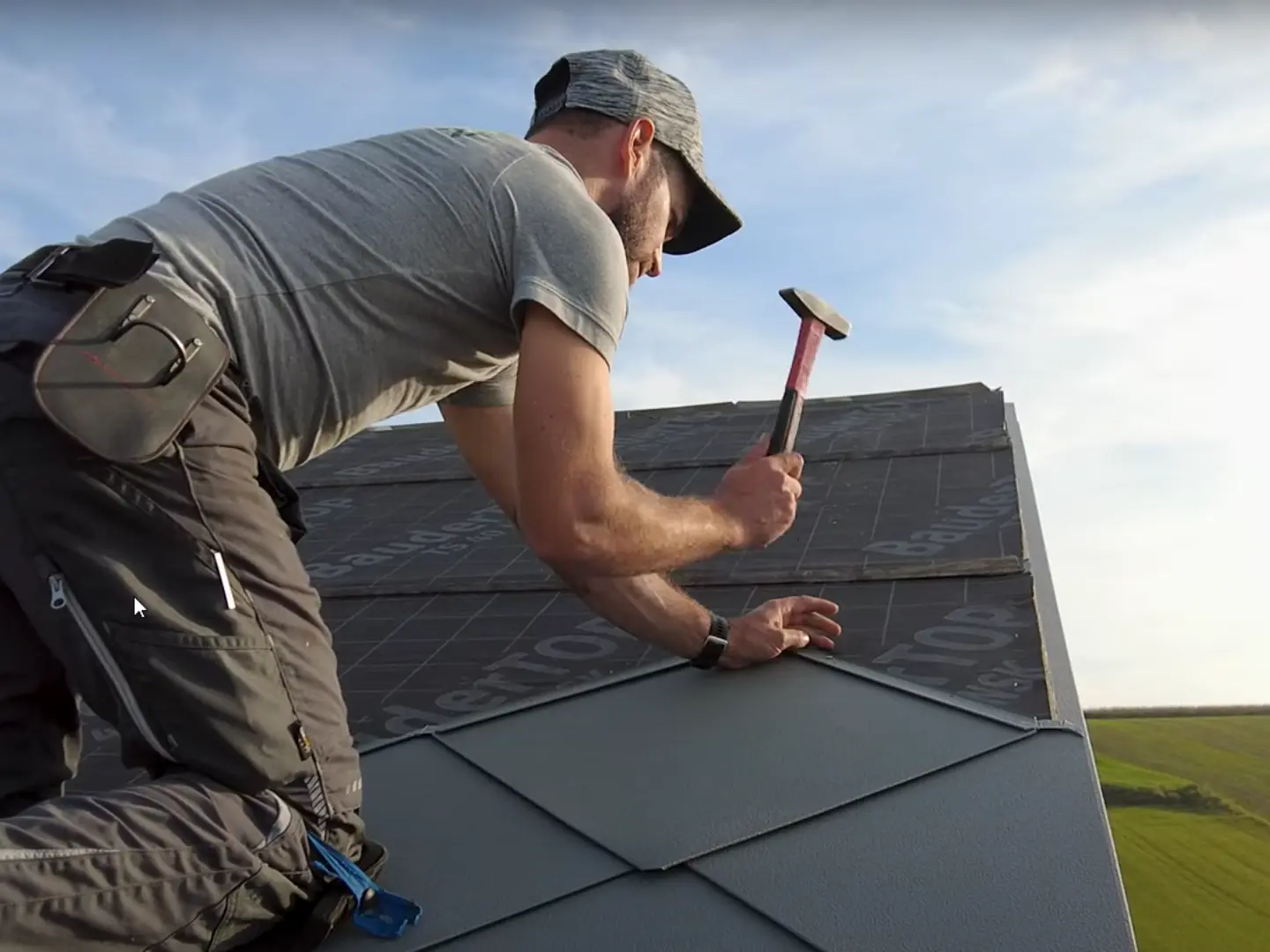
Separating layers must not absorb or store water, must not allow driving rain to pass through and must withstand temperatures directly beneath the metal roof. Depending on the function that a separating layer is to assume, a suitable product must be agreed with the manufacturer of the separation layers. If, for example, the separation layer’s function is to provide additional sound insulation, the use of stronger, heavier bituminous separation layers is recommended by PREFA.
Note
In addition to the framework conditions specified above, the manufacturer’s information on the arrangement of separation layers is defined by PREFA as follows:
- With snow loads greater than 3.25 kN/m² or in terrain categories 0, I or II, installation with a separation layer is required.
- With a roof pitch up to 25°, a separation layer is required for R.16 roof tiles, DS.19 shingles and FX.12 roof panels.
- For roof structures with an unheated (ventilated) roof space, a sub-roof must comply with the requirements of national regulations (sub-roof standards), and at least a separation layer is required.